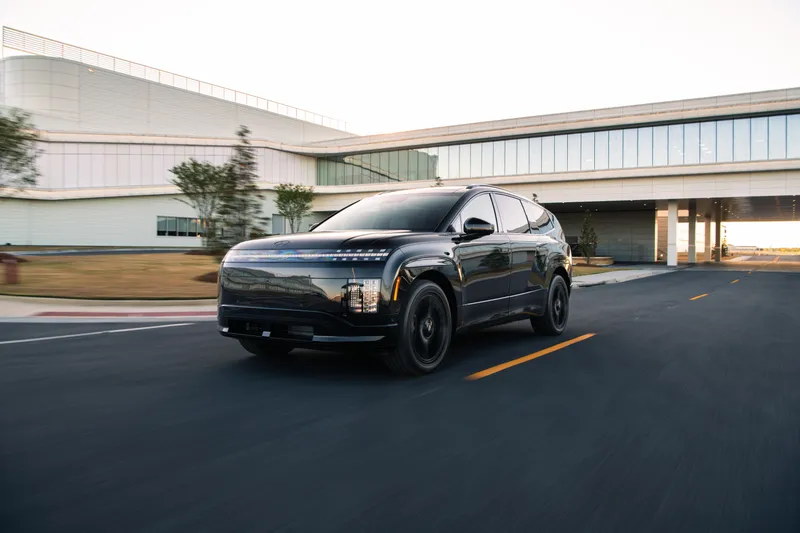
- Range
- 515 km on the Preferred AWD and the Luxury AWD, 500 km on both Ultimate Calligraphy AWD+ cars, on the same 110.3 kWh pack. Range falls at the top of the range rather than rising: the Calligraphy swaps the 70 kW front motor for a second 160 kW one (303 hp becomes 422 hp), wears 21-inch wheels, and weighs about 120 kg more. Hyundai's NRCan consumption ratings move the same way, 2.7 Le/100 km combined on the first two and 2.8 on the Calligraphy. The Night Package is a package on the Calligraphy and has no column of its own in Hyundai's table, so its 500 km is the Calligraphy's figure and not a separately published one. Read 2026-10-17 from https://www.hyundaicanada.com/en/showroom/2027/ioniq-9/specs
- Battery
- 110.3 kWh, the same pack on all four trims. DC fast charging takes it from 10 to 80 per cent in as little as 24 minutes at 350 kW, and the charge port is NACS with CCS adapters. Hyundai lists maximum voltage as 610 V. An earlier version of this note said "800V charging", which Hyundai's own specification table does not support and which is corrected here; the 350 kW figure was right. Read 2026-10-17 from https://www.hyundaicanada.com/en/showroom/2027/ioniq-9/specs
- Price
- MSRP before incentives and fees for the Preferred AWD, the trim Hyundai Canada prices for model year 2027. Read 2026-10-13 from https://www.hyundaicanada.com/en/vehicles/all-vehicles
- Seats
- Seven on the Preferred AWD and the Luxury AWD; six on both Ultimate Calligraphy AWD+ cars, where second-row captain's chairs replace the bench. The dearest trim carries one passenger fewer than the cheapest, which on a three-row SUV is the difference most worth knowing. Read 2026-10-16 from https://www.hyundaicanada.com/en/showroom/ioniq-9
- Drivetrain
- All-wheel drive on every trim; Hyundai lists no rear-drive 2027. Preferred and Luxury use a 70 kW front and 160 kW rear motor, both Calligraphy cars 160 kW at each end. Read 2026-10-16 from https://www.hyundaicanada.com/en/showroom/ioniq-9
- Vehicle-to-Load
- Hyundai lists the two-way on-board charger as available rather than standard, so this records that the model offers it and not that every trim has it. Read 2026-10-16 from https://www.hyundaicanada.com/en/showroom/ioniq-9
- Vehicle-to-Home
- The vehicle's hardware supports it. Hyundai's E-GMP platform carries a two-way on-board charger -- Hyundai Canada advertises an "Available Vehicle to Load (V2L) Two-Way On-Board Charger" on the IONIQ 9 -- and Electric Autonomy Canada (2024-03-25) names "all Hyundai, Kia and Genesis EVs built on Hyundai's E-GMP platform" as having vehicle-to-home capability. AutoTrader.ca (2025-12-18) lists the IONIQ 5, IONIQ 6, IONIQ 9, EV6, EV9 and GV60 among vehicles available in Canada "capable of bidirectional EV charging beyond simple V2L applications". The car is not the obstacle; the home equipment is. As of 2026-11-02 the only vehicle-to-home system this catalogue can establish as sold and installed in Canada is Tesla's Powershare, which works only with the Cybertruck, so there is no Canadian route to the equipment for this car. No manufacturer sells it here either: Hyundai Home is a United States programme, and Wallbox's Quasar 2 -- the bidirectional charger paired with the Kia EV9 -- opened pre-orders in seven United States states.
- Cabin heating
- Standard on every trim, listed under Performance Features in each trim's own panel as "Heat pump, battery thermal management, and preconditioning system". A heat pump is the single biggest factor in how much range an EV keeps in the cold. Read 2026-10-16 from https://www.hyundaicanada.com/en/showroom/ioniq-9
- Trims
- Four trims, at MSRP before fees. Hyundai shows a "Starting at" price that includes freight, PDI and levies -- $68,144 against $64,999 on the Preferred AWD -- and the $3,145 difference is identical across all four. The catalogue stores MSRP everywhere else, so MSRP is what is here. No trim carries its own range. Read 2026-10-16 from https://www.hyundaicanada.com/en/showroom/ioniq-9