Buyer’s guide · Updated 2026-08-30

Best EV Charger Rebate & Reward Programs in Canada

Six Canadian programs reward you for charging an EV at home. Three bundle hardware or cash-back with your charger. Three are provincial: demand-response payouts in Ontario and Quebec, a one-time charger rebate in BC. Deposits range from $0 to $500. Payouts range from one-time rebates to 10 cents per kWh by July 2026.

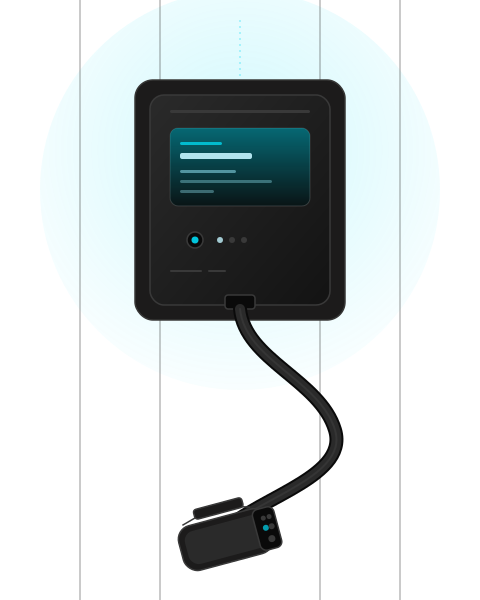
Wall-mounted Level 2 EV charger with cable curving down to a J1772 connector

At a glance

All six Canadian charger reward and rebate programs.

Hardware rewardProvincial
Group 1 of 2

Hardware rewards programs

These three programs ship you a smart Level 2 charger (or work with one you already own) and pay cash-back per kWh you charge through their network.

01 / 03
Hardware reward

Grizzl-E Club

All Canada

The Grizzl-E Club is a Canadian program from United Chargers that ships you a Level 2 home charger in exchange for a refundable deposit and a commitment to participate in their connected charging network. Through 2024 and 2025, public reporting placed the deposit between $100 and $500 depending on plan and charger model. Community reports suggest the deposit may now be reduced, or removed entirely, in newer plans. Hardware quality is the standout. Grizzl-E units have a strong reputation as some of the most rugged, cold-weather-tolerant Level 2 chargers you can buy in Canada. Deposit terms have shifted multiple times since launch and may shift again, so confirm the current numbers on the Grizzl-E Club page before you sign up.

Upfront cost
Refundable deposit (recently $100 to $500; may be reduced or removed, verify on signup)
Refund / payout
Deposit refund after a qualifying charging session or kWh threshold (varies by plan), plus ongoing cash-back per kWh charged
Hardware
Grizzl-E Classic, Pro, or Pro Plus (Canadian-built Level 2)
  • Deposit amount and refund trigger have changed over time. Confirm current terms on signup.
  • Requires reliable internet at the install location for telemetry.
  • Hardware is well-suited to cold-weather installs like cottages and rural homes.
Visit Grizzl-E Club
02 / 03
Hardware reward

SWTCH Home Charging Program

All Canada

SWTCH Energy is a Toronto-based EV charging network. Its Home Charging Program supplies eligible single-family homeowners with a Level 2 charger of up to 48A against a $300 deposit, not free outright. You choose a model, pay the deposit, install the unit and connect it over Wi-Fi. Earning starts immediately at 3 cents per kWh, which SWTCH describes as a temporary starting rate. Once the charger has recorded 1,500 kWh, roughly three to five months for an average driver, the $300 deposit is refunded in full and the rate rises to 11 cents per kWh. Payouts go by direct deposit once your balance passes $100. The program is funded through Canada's Clean Fuel Regulations carbon credits and is built to stack with provincial rebates such as the BC Hydro charger rebate and Quebec's Écorecharge grant. Internet at the install location is required so SWTCH can track charging sessions.

Upfront cost
$300 deposit, refunded in full at 1,500 kWh
Refund / payout
3¢ per kWh to start, then 11¢ per kWh once the deposit is refunded; paid by direct deposit above a $100 balance
Hardware
SWTCH-supplied free Level 2 home charger
  • $300 deposit up front, refunded in full once the charger records 1,500 kWh.
  • The 3¢ per kWh opening rate is temporary; it becomes 11¢ after the deposit is refunded.
  • $100 balance threshold before your first payout.
  • Single-family homeowners only (not multi-unit residential at this time).
  • Requires reliable internet for telemetry.
Visit SWTCH Home Charging Program
03 / 03
Hardware reward

ChargeLab Rewards

All Canada

ChargeLab Rewards is a software-only program for Canadian EV owners who already have, or are willing to buy, a compatible OCPP smart charger. There is no deposit, subscription, or registration fee, and no hardware swap. You connect a supported charger to the ChargeLab app and start earning. The rate rose to 10 cents per kWh on July 1, 2026 and applies anywhere in Canada with no tiers and no minimum payout. Worth being clear about the scale: ChargeLab's own calculator puts an average 3,500 kWh year at about $350 earned against roughly $343 of electricity, so the reward broadly offsets the power rather than turning a profit. Rewards are paid quarterly as gift cards you choose, with cash payouts said to be coming by the end of 2026, plus $25 for each friend who connects a charger. Supported chargers include Autel Home, Wallbox Pulsar Plus, Siemens VersiCharge, Home EVL007, and Grizzl-E Smart; other OCPP chargers may work with extra setup.

Upfront cost
No deposit, no subscription, no registration fee
Refund / payout
10¢ per kWh, paid quarterly in gift cards you choose (cash payouts said to be coming by end of 2026); $25 per referral
Hardware
Compatible OCPP smart charger: Autel Home, Wallbox Pulsar Plus, Siemens VersiCharge, Home EVL007, Grizzl-E Smart (other OCPP chargers may work with extra setup)
  • You must already own (or buy) a compatible OCPP smart charger.
  • Now 10¢ per kWh — the step-up from 3¢ took effect July 1, 2026.
  • Paid in gift cards, quarterly. Cash payouts are promised by end of 2026 but are not live yet.
  • Rewards roughly offset the electricity cost rather than exceeding it.
  • No deposit, no hardware swap, no subscription fee.
Visit ChargeLab Rewards
Group 2 of 2

Provincial utility programs & rebates

These provincial programs either reward you for shifting your load during grid stress events, or provide a one-time rebate on the charger itself.

01 / 03
Provincial

IESO Peak Perks

ON

IESO Peak Perks is an Ontario demand-response program run through Save on Energy. Participants enrol an eligible smart device (originally smart thermostats, with some EV charger integrations announced through partner networks) and earn an annual reward in exchange for letting the program briefly reduce their load during summer peak events. Unlike the hardware rewards programs, Peak Perks does not pay per kWh. It pays for the right to dispatch your load. EV charger eligibility through Peak Perks is partner-dependent and still evolving, so check the current device list on Save on Energy before you assume your charger qualifies.

Upfront cost
No deposit; possible enrolment incentive
Refund / payout
Annual reward for enabling load reduction during summer peak events
Hardware
Enrolled smart thermostat; EV charger integration depends on partner
  • Ontario only.
  • EV charger eligibility depends on partner integration. Verify before enrolling.
  • Pays annually for letting the program manage your load, not per kWh.
Visit IESO Peak Perks
02 / 03
Provincial

BC Hydro EV Charger Rebate

BC

BC Hydro administers a one-time rebate program, in partnership with the Government of B.C., for residential Level 2 EV charger purchase and installation. Separate rebate streams exist for single-family homes, multi-unit residential buildings, and workplace chargers, with top-up amounts available in some cases. Unlike the hardware rewards programs, BC Hydro does not pay ongoing per-kWh cash-back, and it does not run a residential demand-response pilot for EV owners. The benefit is a one-time installation rebate. Eligibility and exact dollar amounts depend on the program stream, so check BC Hydro's rebates page for the current values. The BC Hydro rebate stacks with SWTCH's Home Charging Program. SWTCH explicitly lists it as a compatible incentive.

Upfront cost
No deposit
Refund / payout
One-time rebate on Level 2 charger purchase and installation (amount varies by program and dwelling type)
Hardware
Eligible Level 2 charger purchased and installed at a BC residence
  • British Columbia only.
  • One-time installation rebate, not ongoing rewards. Stacks with hardware rewards programs.
  • Separate streams for single-family, multi-unit, and workplace chargers.
Visit BC Hydro EV Charger Rebate
03 / 03
Provincial

Hilo (Hydro-Québec)

QC

Hilo is Hydro-Québec's smart-home and demand-response program, built around the Flex D tariff. Quebec households on Flex D pay a lower rate most of the year in exchange for a higher rate during winter peak events ("événements de pointe"). Hilo automatically reduces the consumption of enrolled connected devices during those events, so participants save money instead of paying the peak rate. Hilo lists Level 2 EV chargers among its compatible device categories, but specific charger compatibility should be confirmed in the Hilo product catalogue. Hilo advertises roughly 100 hours, or 25 peak events, across a winter season. The program is Quebec-only and is centred on the Flex D rate plan. Participants on standard rate D do not see the same savings.

Upfront cost
Hardware purchase or rental (varies by device)
Refund / payout
Bill savings via the Flex D tariff during winter peak events (no per-event cash payment)
Hardware
Hilo-compatible smart device; Level 2 EV chargers are part of the compatible device ecosystem
  • Quebec only, for Flex D tariff customers.
  • Savings come from the tariff differential, not per-challenge cash rewards.
  • About 100 hours, or 25 peak events, per winter season on average.
Visit Hilo (Hydro-Québec)
Decide

How to pick the right program

Three branches cover most situations. Stack a provincial offer on top if your province has one.

01
No Level 2 charger yet?
Start with SWTCH.

A $300 deposit gets you a Level 2 unit, refunded in full once the charger records 1,500 kWh. Earning starts at 3 cents per kWh and rises to 11 cents once the deposit comes back. Grizzl-E Club is the alternative if you want the rugged Canadian-built hardware.

02
Already own a smart charger?
ChargeLab Rewards.

No hardware swap, no deposit. The rate rose to 10 cents per kWh on July 1, 2026 and is paid quarterly in gift cards, with cash payouts promised by the end of 2026.

03
In Ontario, Quebec, or BC?
Add the provincial offer.

Peak Perks in Ontario, Hilo (Flex D) in Quebec, or the BC Hydro EV Charger Rebate. Usually stackable with a hardware rewards program. Verify with each provider before signing up for both.

Reference

Frequently asked questions

Can I have one of these chargers at my home and another at the cottage?

In most cases yes, as long as each location has its own qualifying setup: separate address, separate charger serial number, separate account, reliable internet. ChargeLab explicitly limits one account per charger. Grizzl-E and SWTCH do not appear to restrict multi-property enrolment, but you should confirm directly with the program before signing up for a second location.

Do I need a specific charger model to join Grizzl-E Club?

Yes. The Grizzl-E Club ships you a Grizzl-E-brand Level 2 charger (Classic, Pro, or Pro Plus, depending on plan). You cannot enrol an existing third-party charger in the program. The hardware is Canadian-built and rated for cold-weather installs.

Does the SWTCH program still require a deposit?

Yes. SWTCH takes a $300 deposit when you choose your charger, and refunds it in full once the unit has recorded 1,500 kWh — roughly three to five months of average driving. Earning starts immediately at 3 cents per kWh, which SWTCH describes as a temporary starting rate, and rises to 11 cents per kWh after the deposit is returned. Payouts go by direct deposit once your balance passes $100. Coverage from the December 2025 launch describing a free charger with no deposit no longer matches the program as it is offered today.

What happens if my cottage internet drops out?

All of the hardware rewards programs (Grizzl-E Club, SWTCH, ChargeLab) rely on internet telemetry to track charging sessions and pay rewards. Extended offline periods can delay refund qualification, reduce payouts, or in extreme cases affect membership status. If your cottage runs on Starlink, LTE, or unstable DSL, expect occasional gaps. Programs do not usually penalise short outages, but a seasonal property that sits offline for months is worth flagging to the provider before you enrol.

Are these programs available in my province?

Grizzl-E Club, SWTCH, and ChargeLab Rewards are open to eligible homeowners across Canada. IESO Peak Perks is Ontario-only. The BC Hydro EV Charger Rebate is British Columbia-only. Hilo is Quebec-only. The comparison table above shows province availability for each program at a glance.

Do these programs stack with provincial EV rebates?

In most cases yes. Charger reward programs are independent of vehicle-purchase rebates. The Quebec, BC, and PEI vehicle rebates apply to the car, not the charger. Some provinces (notably Quebec via Roulez Vert and BC via CleanBC) offer separate charger rebates that you may be able to claim alongside a charger reward program. Confirm with each program that combined participation is allowed before you apply.

Do these programs stack with the federal EVAP rebate?

Yes. The federal EV Affordability Program (EVAP) rebate is a vehicle-purchase incentive. It is independent of any home charger reward program. You can claim EVAP on the vehicle and enrol your home charger in Grizzl-E Club, SWTCH, or any of the other programs without affecting EVAP eligibility.

Can I leave the program later and keep the charger?

It depends on the program. Hardware rewards programs typically include language about charger ownership in their terms. Sometimes the charger transfers to you outright after the refund threshold, and sometimes it remains program-owned. Check the ownership clause in the specific program terms before you sign up.

What's the difference between hardware rewards, utility demand-response, and a charger rebate?

Hardware rewards programs (Grizzl-E Club, SWTCH, ChargeLab) pay you per kWh you charge through their connected charger network. Utility demand-response programs (IESO Peak Perks, Hilo) pay you, or lower your rate, in exchange for letting your utility briefly reduce or shift your load during grid stress events. The BC Hydro EV Charger Rebate is different again. It is a one-time installation rebate, not ongoing rewards. The three categories can often be stacked. SWTCH, for example, lists BC Hydro's rebate and Quebec's Roulez Vert as compatible incentives.

Do I need smart-meter or time-of-use billing to participate in utility programs?

For utility demand-response programs, yes. Your utility needs to read your usage at fine enough granularity to verify the load reduction and pay you for it. Most Canadian provinces already operate on smart-meter billing for residential customers, but if you are on a flat rate or a non-time-of-use plan, contact your utility about switching before you enrol.

How often do these program terms change?

Frequently. The hardware rewards programs in particular (Grizzl-E Club, SWTCH) have updated their deposit structures, refund triggers, and member benefits multiple times since launch. The "Last verified" stamp at the top of this page shows when we last confirmed the program details against official sources. Always click through to the official program page before you sign up.

Are any of these programs accepting new members from rural or northern areas?

All six programs accept rural and northern members in principle, subject to eligibility. The practical constraint is internet reliability. Programs that rely on telemetry need a usable connection. Demand-response programs also need a smart meter and a utility that operates the program in your service area. Northern off-grid or satellite-internet-only locations can participate, but expect more friction.
Sources & last verified

Last verified 2026-08-30