Canada Has a Plan to Plug EVs Into the Grid. Here's What Your EV Can Power Today.
Dunsky Energy + Climate Advisors announced the Canadian Vehicle-Grid Integration (VGI) Alliance this week. The idea is to get utilities, governments and automakers working from the same rulebook so EVs can send power back to homes and the grid, instead of every project being a one-off pilot. BC Hydro, Manitoba Hydro and General Motors are among the backers, and the Government of Canada is involved as a strategic collaborator.
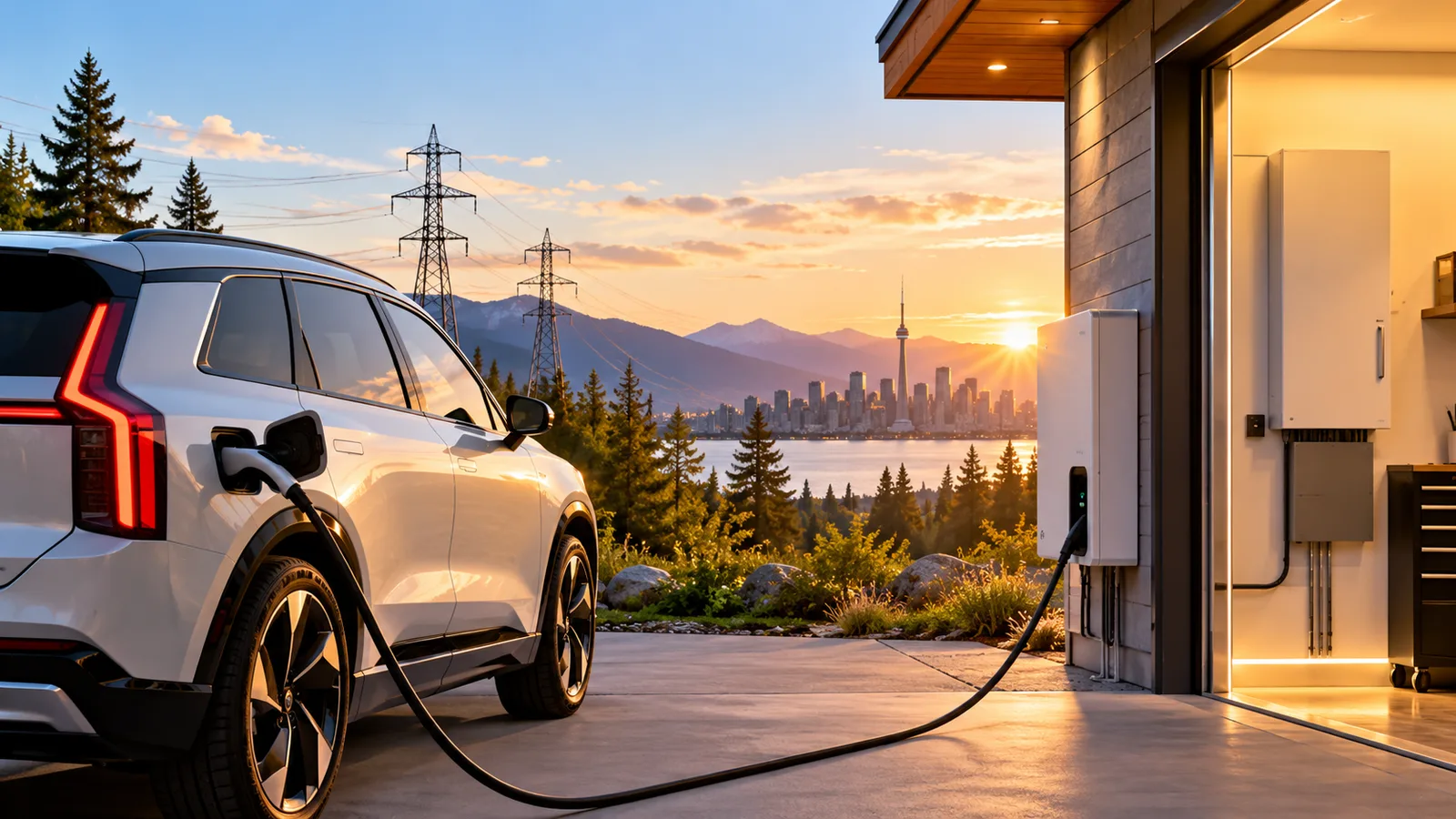
I think it's the right problem to work on. A typical EV battery holds somewhere between 60 and 100 kWh. Multiply that by a few million cars parked in driveways and you have a very large battery that nobody is coordinating.
The hard part is getting everyone to agree. Carmakers, charger makers and utilities have to settle on standards and safety rules, and then the regulators have to sign off. Canada makes that harder than it needs to be, because equipment approved by one utility may not be approved by the next one over, or in the next province.
The alliance hasn't announced a deployment schedule or any adoption targets. An online VGI Knowledge Centre is supposed to launch later this fall. So nobody should read this as V2G showing up in their driveway next year.
What the acronyms mean
They get used as if they mean the same thing. They don't.
V2L (vehicle-to-load) is the simple one. The car has a built-in outlet or takes an adapter, and you plug things straight into it. Tools at the cottage, a campsite, a few essentials during an outage. No home installation needed.
V2H (vehicle-to-home) feeds your house's electrical system. That takes compatible bidirectional charging equipment and a proper install, and in return the car can carry household circuits through an outage. Some setups can also shift your usage away from expensive peak periods.
V2G (vehicle-to-grid) sends power back to the utility, and only under an approved program. Smart charging, sometimes called V1G, doesn't export anything at all. It just picks better times to charge, which lowers the owner's cost and takes some load off the grid.
A car that does V2L may not do V2H or V2G. Even when a manufacturer advertises bidirectional charging, the equipment, software or utility approval it needs may not be available in Canada yet.
What you can use today
V2L is the part that's real right now. The Kia EV9 and the Ford F-150 Lightning both have it, along with several other models EVD2 tracks. They go about it differently. Some give you ordinary household outlets, others have higher-capacity systems or the manufacturer's own home backup package.
Here's the rough math. Take an 80 kWh battery and hold 60 kWh of it for backup. At an average household draw of 1 kW, that's about 60 hours, before conversion losses. The real number depends mostly on what you're running and how much you keep in reserve to actually drive somewhere.
If you have a cottage (we have one on Koshlong Lake), camp a lot, or lose power a couple of times every winter, power export belongs on your list next to range, charging speed and price.
Finding these on EVD2
The catalogue filters on all three. You can list every V2L vehicle, every V2H one, and every V2G one, and the side-by-side comparison shows a Power Export spec for each model.
The V2G list is empty, and that is the argument of this piece in one click. Not one vehicle in the Canadian catalogue can export to the grid under an approved program today. The alliance is trying to change that, and until it does, the useful filters are the other two.
One caveat, and it's ours rather than the industry's. The filter lists the vehicles we have checked, and the catalogue page says how many that is. A car missing from the list is usually a car nobody has looked at yet, not a car that can't do it. We're working through the rest.
Check the exact Canadian model year and trim before you buy. A V2H listing tells you the car supports it. Whether you can buy an approved home backup system and get it installed today is a separate question.
The most useful thing the alliance could do in its first year is pretty dull: one set of rules that works in more than one province. I think if it gets that done, V2H stops being a pilot project and becomes something an electrician can quote you.